
Transforming researchers’ approach to ethnicity data

Category: Lived Experience
Target audience: Academic researchers
Research innovator: Dr Esther Yao
The project

The aim of this project was to transform how quantitative researchers approach ethnicity data by demonstrating how their methodological decisions shape results and conclusions.
This involved:
Empirically examining the stability and change in longitudinal ethnic identification, and how this differs depending on ethnic classification method; and
Producing an accessible journal manuscript that provides a review and critical discussion on the implications of researchers’ methodological decisions on ethnicity data.
Dr Yao was motivated to pursue this project after identifying these two key gaps over the course of her PhD research.

Ember Innovations research funding Impact
The Ember Lived Experience Research Grant has encouraged Dr Yao to be more open about her own mental health lived experience in academic settings. To her surprise, this resulted in being invited to be a part of two large international grant applications, both of which seek to integrate lived experience into quantitative mental health research.
She was previously unsure about her future career direction, but over the course of the Ember grant, she has developed a strong interest in, and passion for, centring lived experience in quantitative mental health research. She is now excited to explore what this could look like in her career going forward.
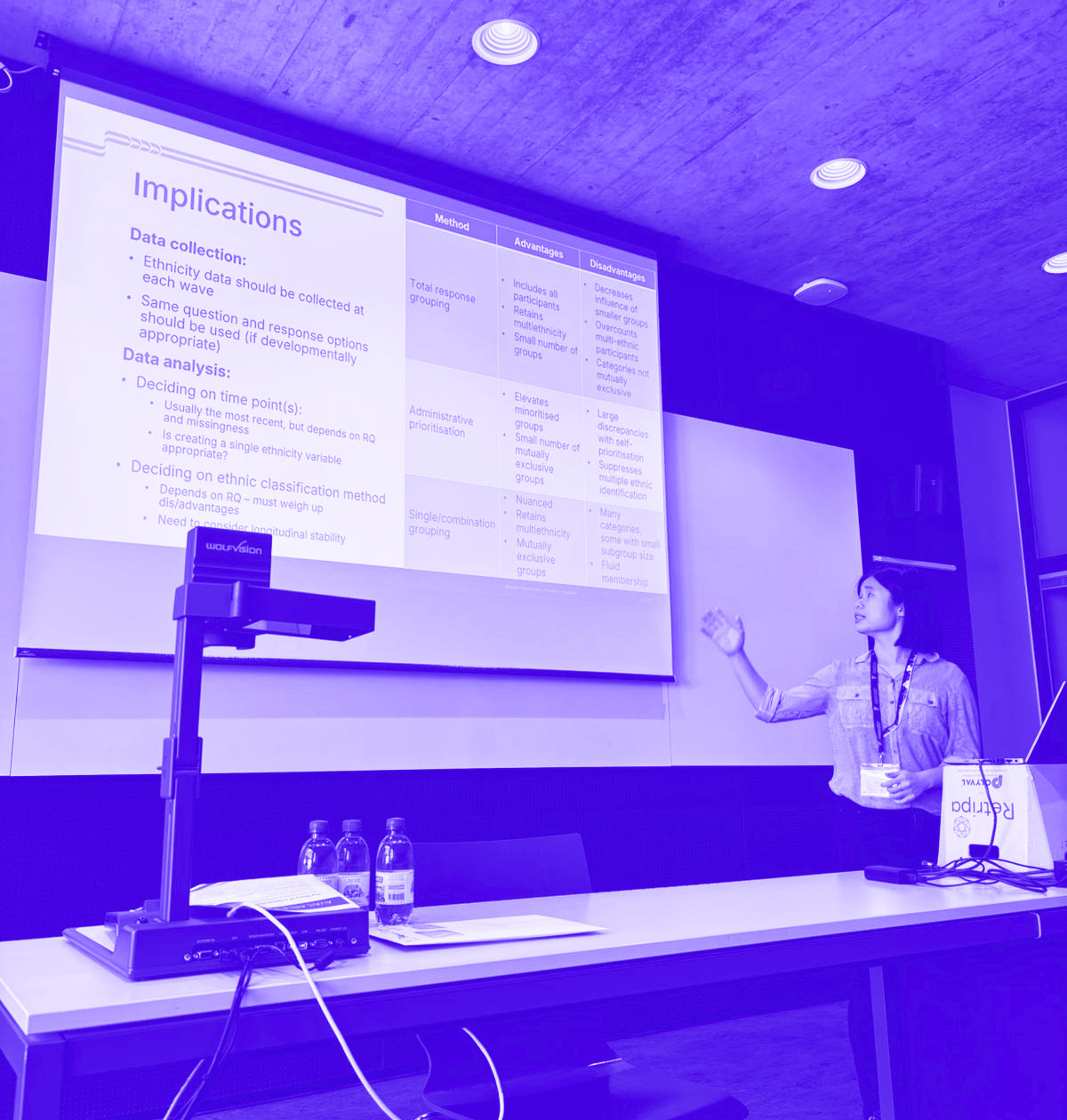
Dr Yao presenting her research at the Society for Longitudinal and Lifecourse Studies (SLLS) Conference in Fribourg, Switzerland in September 2025.

Research grant Benefits
Dr Yao has expressed that the Ember Lived Experience Research Grants are extremely valuable for lived experience researchers and the wider academic and research community for four key reasons.
First, it is a flexible grant that supports researchers in their chosen field. In light of the often precarious nature of academic research (not great for mental health!), this is particularly helpful for early career researchers who are seeking to find their feet and direction post-PhD.
Second, the grant encourages recipients to recognise and share their lived experience as a form of strength and expertise. This idea was fairly new to Dr Yao, who found it extremely empowering, having previously considered her mental health challenges a source of shame that was best hidden.
Third, in Dr Yao’s case, opening up about her lived experience unexpectedly resulted in opportunities to further her academic career by being invited to grant applications as a lived experience expert.
Last but not least, encouraging researchers to share their mental health lived experience in academic settings is an important step towards addressing the stigmatisation of, and discrimination towards, people experiencing mental ill-health. Dr Yao is hopeful this will contribute to the university sector becoming a more safe, inclusive, and supportive space, where mental wellbeing is increasingly valued and prioritised.

Related publications and resources
Yao, E. S., Meissel, K., Atatoa Carr, P., Bullen, P., Peiris-John, R., Manuela, S., & Clark, T. C. (2025). Unpacking tick-boxes: Considerations and recommendations for collecting, analysing, and interpreting ethnicity data. Journal of the Royal Society of New Zealand, 55(6), 1432–1451. https://doi.org/10.1080/03036758.2025.2467275
Yao, E. S., Atatoa Carr, P., Meissel, K., Bullen, P., Peiris-John, R., Manuela, S., & Clark, T. C. (2025). Ethnic identification from pre-birth to early adolescence: Longitudinal patterns and methodological considerations. Journal of Population Research, 42(3), Article 40. https://doi.org/10.1007/s12546-025-09392-z
Yao, E. S., Meissel, K., & Clark, T. C. (2025). Ethnic identification from pre-birth to early adolescence: Stability, change, and the impact of ethnic classification method. Paper presented at the Society for Longitudinal and Lifecourse Studies (SLLS) Annual International Conference, Fribourg, Switzerland. https://www.slls.org.uk/events/2025-slls-annual-international-conference
Meissel, K., Grant, M., Rudd, G., & Yao, E. S. (2025). Why method matters: Unpacking the implications of researcher decisions in quantitative longitudinal research. Paper presented at the Society for Longitudinal and Lifecourse Studies (SLLS) Annual International Conference, Fribourg, Switzerland. https://www.slls.org.uk/events/2025-slls-annual-international-conference